 Modelling4Comfort
Henrhyd Falls - Build Log #006: Finalisation & Details
Bringing Scale and Life to the Scene
Timeline: 25 November 2025
Focus: Adding human presence for scale, completing the hidden pathway, and celebrating the finished diorama
With the major construction complete - base, rocks, waterfall, and woodland vegetation - the diorama possessed dramatic beauty but lacked one critical element: a sense of human scale and accessibility. The real Henrhyd Falls is a destination, a place people visit and experience. To capture this essence, the finalisation phase focused on two key storytelling elements:
- A human figure - positioned to the left of the waterfall, establishing scale and suggesting the falls’ accessibility
- A hidden pathway - following the stream on the right, winding through deep vegetation and under trees, allowing passage to the far side of the falls behind the cave
This phase also represents a celebration - viewing the completed work from multiple angles, discovering different focal points, and appreciating how all elements work together to create a cohesive Welsh woodland scene.
The Scale Figure - Human Presence
Purpose and Positioning
The miniature figure serves multiple narrative and compositional purposes:
Scale Establishment: At 1:250 scale, a typical 1.75m (5’9”) person measures approximately 7mm tall. This tiny figure immediately communicates the dramatic scale of the 27-meter waterfall and towering cliff faces.
Accessibility Narrative: The figure suggests this is not just a remote wilderness feature but an accessible destination - someone can stand here, experience this view, feel the waterfall spray.
Compositional Balance: Positioned to the viewer’s left of the waterfall, the figure creates a subtle focal point that doesn’t compete with the dramatic water feature while adding human interest.
Location Choice: Placed at the base of the falls, the figure appears to be viewing the cascade - a natural position tourists adopt when visiting the real Henrhyd Falls.
Wire Frame Construction
Building a convincing 7mm figure required careful planning:
Wire Armature:
- Started with fine wire creating basic skeletal structure
- Proportions critical at this tiny scale - head roughly 1/7 of total height
- Wire provided bendable structure allowing natural standing pose
- Formed basic stick figure with legs, torso, arms, and head structure
- Wire thin enough to allow delicate shaping but strong enough to maintain pose
Pose Selection:
- Chose standing position facing the waterfall
- Slightly relaxed stance suggesting someone pausing to admire the view
- Arms at sides or perhaps one hand shielding eyes from spray
- Natural, believable posture rather than rigid stance
Air Dry Clay Application
With the wire armature established, the figure-building process continued:
Clay Selection:
- Used air dry clay (self-hardening modeling clay)
- This material doesn’t require kiln firing - ideal for small-scale work
- Remains workable while wet, hardens completely when dry
- Accepts detail work and can be painted when cured
Building Up the Form:
- Applied small amounts of clay to wire armature
- Built up body mass gradually - torso, legs, arms, head
- Worked to maintain correct proportions at 7mm scale
- Smoothed clay while wet to create basic body form
- Suggested clothing folds and basic anatomical shapes
- Allowed clay to dry completely (24-48 hours depending on thickness)
Dremel Detailing
Once the air dry clay hardened, the refining process began:
Why Dremel Work:
- Wet clay can only be shaped to certain fineness before it becomes too soft
- Dried clay allows precision carving and texturing impossible when wet
- Dremel rotary tool provides control for tiny detail work at 7mm scale
Detailing Technique:
- Used fine Dremel bits and sanding attachments
- Refined clothing folds and wrinkles suggesting fabric texture
- Defined separation between legs, arms, and body
- Carved subtle facial features (at 7mm, just suggestions rather than detail)
- Smoothed rough areas and corrected proportion issues
- Created texture variations suggesting different materials (clothing, hair, skin)
- Worked slowly to avoid removing too much material
Result:
- A believable human figure at 1:250 scale
- Enough detail to read as “person” without being overly fussy
- Natural pose suggesting someone experiencing the waterfall
- Successfully communicates scale when viewed in context with cliffs and cascade
Integration into Scene
Positioning the finished figure required careful consideration:
- Placed to viewer’s left of waterfall on relatively level ground
- Positioned to appear stable and naturally standing
- Secured to base with adhesive
- May have added small rock or vegetation around base to integrate figure into landscape
- Ensured figure was visible from primary viewing angles but didn’t dominate composition
The figure’s presence transforms the diorama from pure landscape into a scene with narrative - someone experiencing this Welsh natural wonder, providing that crucial human connection.
The Hidden Pathway
Following the Real-World Feature
The real Henrhyd Falls includes a path that allows visitors to walk behind the waterfall through a natural passage behind the cascade - one of the site’s most dramatic experiences.
Pathway Route:
- Begins following the stream on the right side of the diorama
- Winds through the deep vegetation and mature trees
- Passes under the woodland canopy
- Leads toward the far side of the falls
- Suggests continuation behind the waterfall and into the cave area
Construction Approach
Creating a convincing miniature pathway at 1:250 scale:
Path Surface:
- Created worn earth appearance using fine textured materials
- Possibly used modeling paste or fine sand mixed with paint
- Applied in narrow winding strip suggesting footpath
- Slightly depressed below surrounding ground level (paths are worn down over time)
- Color differentiated from surrounding vegetation - earthier brown tones
Vegetation Integration:
- Path winds through the established ground cover
- Dense vegetation flanks both sides creating enclosed feeling
- Overhanging ferns and low bushes suggest path passes under canopy
- Some vegetation allowed to encroach on path edges (not perfectly maintained)
- Strategic placement of trees creates sense of passing “under” the woodland
Directional Flow:
- Path curves naturally following terrain contours
- Begins visible in foreground, disappears behind vegetation
- Reappears suggesting continuation toward falls and cave
- This visible-hidden-visible pattern creates depth and invites eye exploration
Width and Scale:
- At 1:250 scale, a 1m wide path measures 4mm
- This narrow strip required careful application
- Ensured path remained visible but didn’t look like a highway cutting through scene
Narrative Purpose
The pathway adds storytelling dimension:
Accessibility: Like the figure, it suggests this remote gorge can be reached and experienced
Journey: The winding path implies movement - someone has walked here, will walk here again
Discovery: The path leading “behind” the visible areas suggests hidden views, the dramatic behind-falls experience
Connection: Links different areas of the diorama - stream, vegetation, cliff face, cave entrance
Scale Reinforcement: A visible human-made element provides additional scale reference alongside the figure
Celebrating Multiple Perspectives
With the figure and path complete, the diorama reached its final form. The finalisation phase became a celebration - exploring how the scene works from different viewing angles.
The Hero View - Dramatic Waterfall Focus
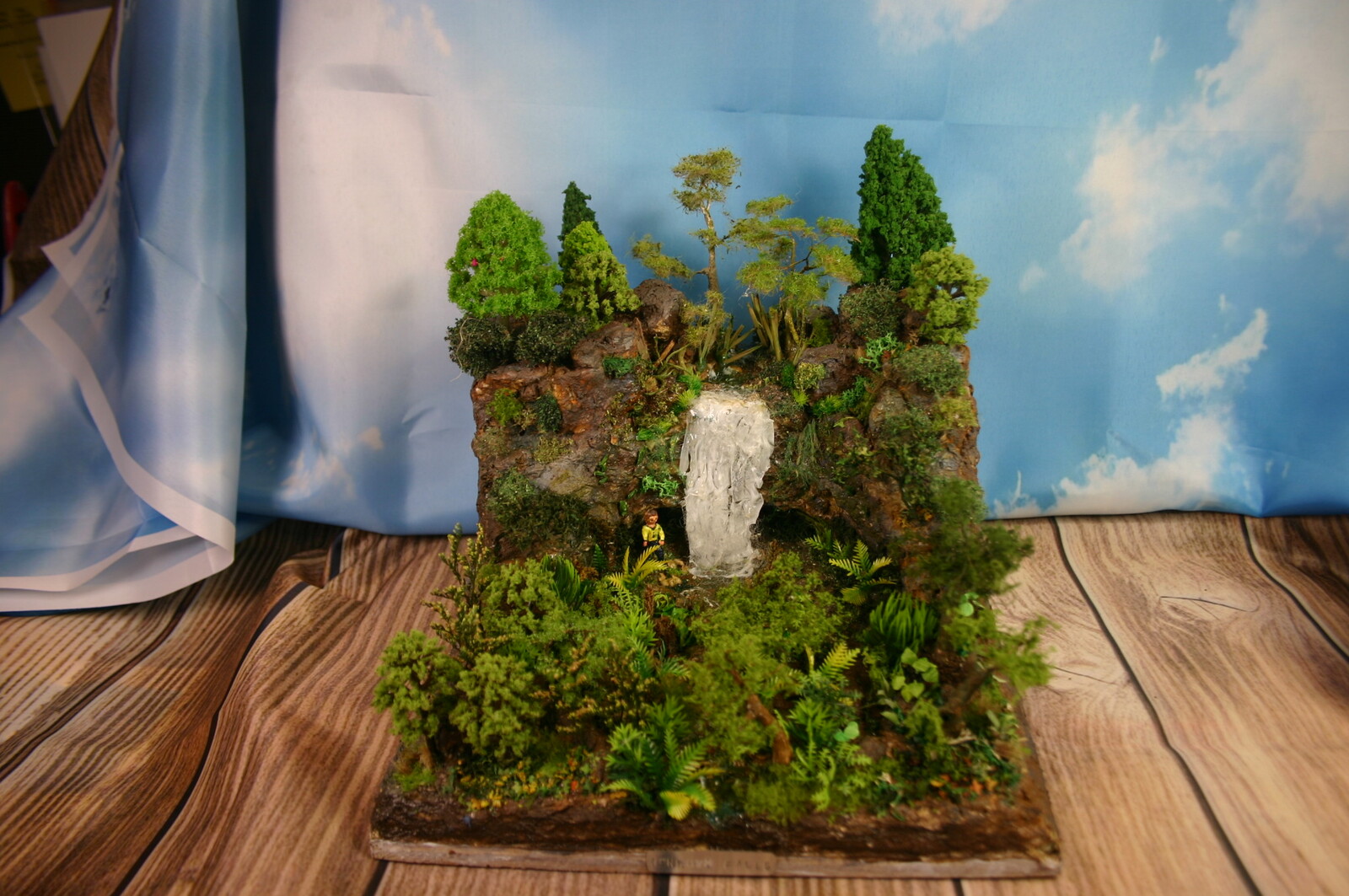 The signature view showcasing the complete Henrhyd Falls diorama. The dramatic 27-meter waterfall (11cm at 1:250 scale) cascades down the vertical cliff face as the central focal point. Dense Welsh woodland frames the scene - mature trees at cliff top, lush ferns and ground vegetation creating temperate rainforest character. The blue sky backdrop enhances the outdoor atmosphere. The scale figure (7mm tall, barely visible to waterfall’s left) and winding path provide subtle human elements without competing with the natural drama. Notice the layered composition: foreground vegetation detail, midground waterfall feature, background framing trees. The moss-covered rocks, varied plant diversity (9 trees in 6 distinct forms, multiple fern types, rich ground cover), and realistic water effects combine to capture the essence of this Welsh natural wonder. This view successfully balances all construction phases - geological drama, botanical variety, atmospheric lighting, and narrative human presence. Rated 9/10 by analysis for composition strength, technical quality, subject interest, and showcase value.
This primary angle showcases:
- Waterfall as undisputed hero feature
- Vertical drama of cliff face
- Lush vegetation framing without overwhelming
- Figure providing scale reference
- Path suggesting accessibility
- Complete integration of all build phases
Close-Up Details - The Intimate Views
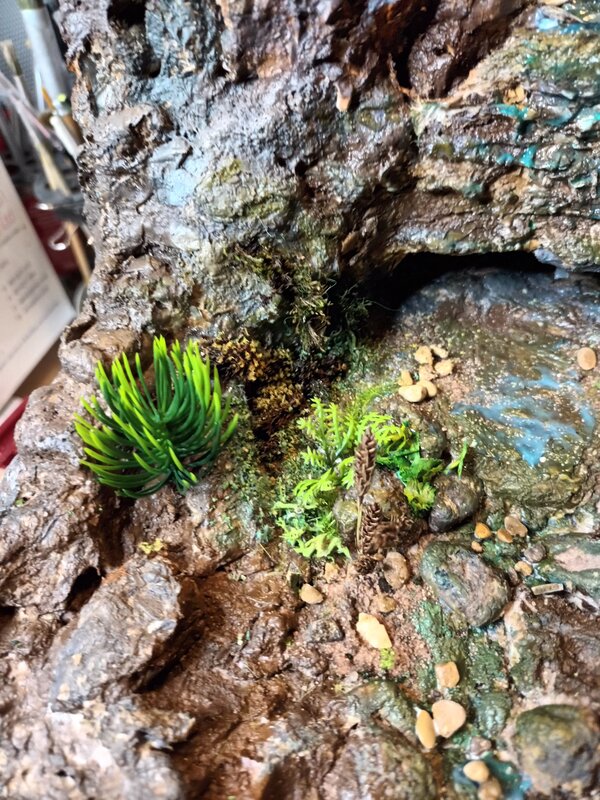 Intimate detail revealing the diorama’s micro-ecosystem. A vibrant green fern nestles perfectly in a rock crevice, moss carpets surfaces with velvety texture, and delicate ground cover plants take advantage of the sheltered microhabitat. The vegetation appears genuinely established - growing FROM the landscape rather than stuck ON it. Natural organic arrangement complements the irregular rock contours. Colors range from deep vibrant fern green to softer muted moss tones, creating rich visual variety. Textures equally diverse: lush feathery fern fronds contrast with velvety moss and delicate ground cover. This close view shows successful integration techniques - crevice insertion, moss concealment of attachment points, clustered planting patterns mimicking natural colonization. Realism rated 9/10 - the placement and growth patterns appear very true to life. At this intimate scale, the meticulous attention to detail becomes apparent: individual plant positioning, color variations, textural contrasts all contributing to believable Welsh gorge atmosphere.
Close viewing reveals:
- Individual plant placement and character
- Moss and lichen coverage on rocks
- Texture variations (smooth rock, velvety moss, feathery ferns)
- Color subtleties in vegetation and stone
- Integration points where vegetation meets geological features
The Figure’s Perspective
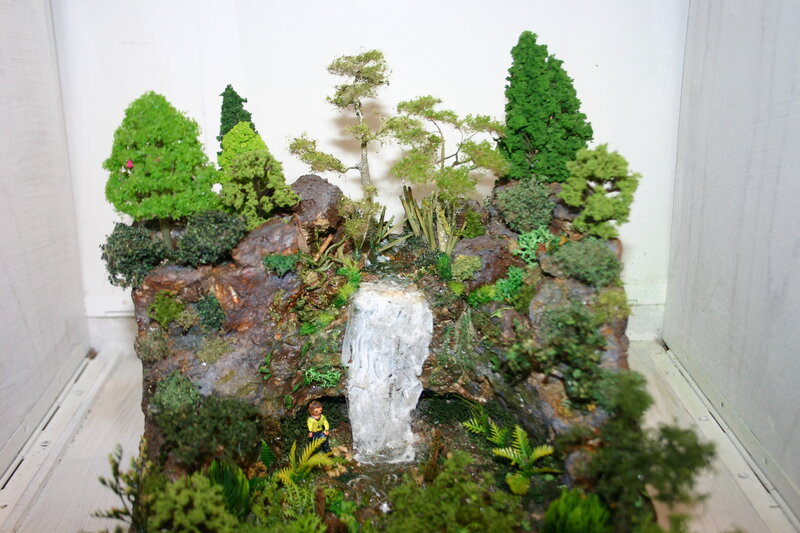 Perspective highlighting the human element. The miniature figure (7mm tall at 1:250 scale representing average person height) stands to the left of the cascading waterfall, immediately communicating the dramatic scale of the 27-meter drop. From this angle, the figure appears to gaze up at the towering cliff and falling water - exactly the experience visitors have at the real Henrhyd Falls. The waterfall spray created by cotton wool and white paint mist captures how the cascade would shower visitors standing in this location. Notice how the figure’s placement on relatively level ground near the pool base suggests accessibility - this is a destination people can reach and experience. The dense vegetation surrounding the figure reinforces the enclosed gorge feeling, while the visible path to the right implies the journey to reach this viewpoint. The figure successfully serves multiple purposes: establishes scale (waterfall towers above), adds narrative (human interaction with nature), provides compositional balance (subtle left-side focal point), and suggests the falls’ accessibility. Without this tiny human presence, the absolute scale of the scene remains ambiguous; with it, the dramatic verticality becomes immediately apparent.
From angles emphasizing the figure:
- Human scale becomes immediately apparent
- Waterfall’s towering height emphasized
- Sense of “being there” - viewer can imagine standing in that spot
- Figure’s gaze direction leads eye to waterfall
- Accessibility narrative strengthened
The Hidden Path View
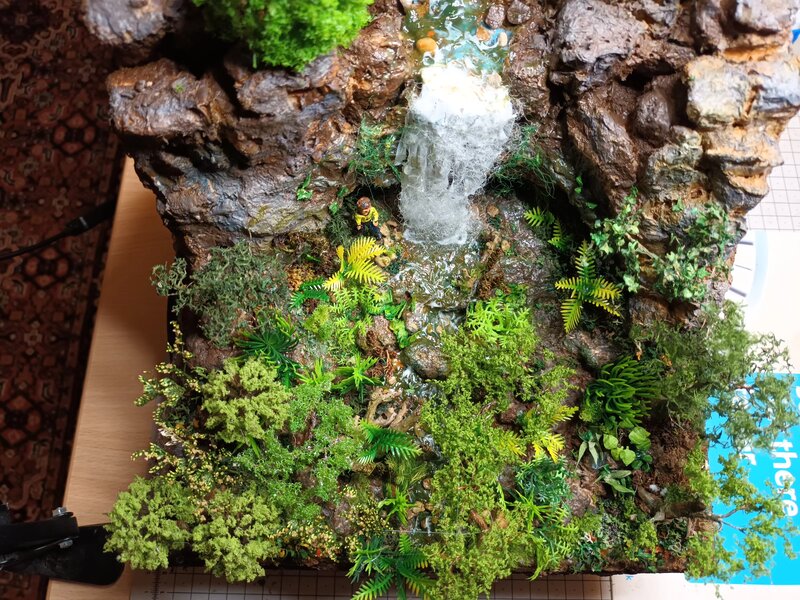 The winding path revealed through the lush Welsh woodland. Following the stream on the right side, the narrow pathway (approximately 4mm wide at 1:250 scale) demonstrates how visitors access the waterfall area. The path weaves through dense ground vegetation - ferns, moss, ground cover in rich greens - creating an enclosed, intimate feel characteristic of walking through ancient woodland. Notice how the vegetation naturally flanks the path: ferns cascade from both sides, small bushes and trees create canopy overhead, moss and forest floor materials define the edges. The path surface shows slightly different coloring from surrounding greenery - earthier brown tones suggesting worn, compacted earth. The route curves and partially disappears behind vegetation, reappearing to suggest continuation toward the waterfall and cave entrance behind. This visible-hidden-visible pattern creates depth and invites visual exploration. Trees positioned to suggest the path passes “under” the woodland canopy enhance the three-dimensional journey. The pathway serves critical narrative function: reinforces accessibility, implies movement and discovery, connects different diorama areas, provides additional human-scale reference alongside the figure.
Pathway-focused views show:
- How access through dense vegetation is possible
- Winding route creating journey narrative
- Path disappearing and reappearing adding mystery
- Vegetation enclosure creating immersive forest experience
- Connection between stream, woodland, and falls areas
Varied Angles - Discovering Focal Points
 Complete scene showcasing dimensional depth and layered composition. This angle reveals how foreground, midground, and background elements work together to create the illusion of looking deep into a Welsh gorge. Lush vegetation dominates: ferns and moss cling to rocks, trees of varying heights establish scale and depth, ground cover creates forest floor richness. The vegetation is strategically dense yet allows visibility of the waterfall cascading over rocks in the background. Notice the layering: detailed ground-level plants in foreground invite close inspection, medium-sized vegetation and rocks create midground visual interest, taller trees at cliff top frame the background. The natural organic arrangement avoids uniform distribution - clusters of dense greenery intersperse with exposed rocky areas and water features. Colors range from deep vibrant greens (ferns, foliage) to silvery-gray (rocks) to brilliant white (cascading water). Textures vary from smooth broad leaves to delicate feathery fronds to rough weathered stone. This integrated placement demonstrates successful compositional strategy: maintaining waterfall as hero feature while surrounding it with rich botanical detail. Realism rated 8-9/10 for diversity and well-integrated placement creating truly lush, pristine natural setting.
Different viewing angles reveal:
- How three-dimensional layering creates depth
- Alternative focal points (not always waterfall-centric)
- How composition changes with viewer position
- New details visible from each perspective
- Complete scene versatility
Lighting and Atmosphere
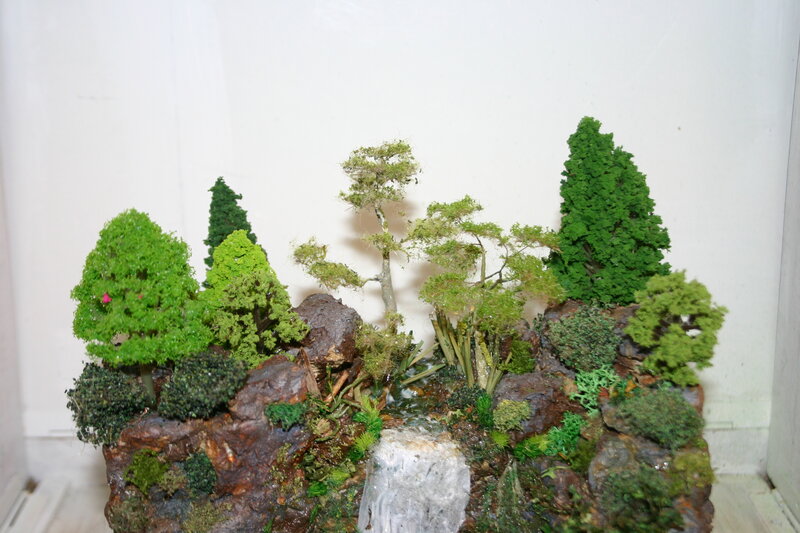 Lighting conditions revealing the diorama’s atmospheric qualities. The interplay of light across the scene highlights key textural elements: the shimmer of water, the velvety appearance of moss, the varied foliage tones, the weathered rock surfaces. Notice how lighting creates depth through subtle shadows - vegetation casts gentle shadows on rocks, cliff face shows dimensional relief through light and shadow play, trees create dappled effects. The white cotton wool waterfall mist catches and reflects light effectively, enhancing the sense of moving, splashing water. Different green tones in the vegetation show more distinctly under proper lighting: light green rounded bushes, vibrant fluorescent green spreading trees, deep green columnar specimens, pale green lacy-leaved plants. The moss coverage on rocks appears softer and more naturalistic when light emphasizes the textural differences between hard stone and soft organic growth. This view demonstrates that the diorama succeeds under varied lighting - no single”optimal” light condition required. Instead, different lighting reveals different qualities: bright light shows color vibrancy and fine detail, softer light enhances mood and atmosphere, angled light creates dramatic shadows emphasizing three-dimensional form.
Lighting variations show:
- How light interacts with water effects
- Shadows creating dimensional depth
- Moss and vegetation appearing softer or more vibrant
- Rock texture more or less pronounced
- Overall mood shifting with lighting conditions
Materials & Tools Used
Figure Construction
- Fine gauge wire for armature (possibly 0.3-0.5mm diameter)
- Air dry clay (self-hardening modeling clay)
- Dremel rotary tool with fine bits and sanding attachments
- Small sculpting tools for clay shaping
- Possibly paint for figure clothing/skin tones
Pathway Construction
- Fine textured materials (modeling paste, fine sand)
- Earth-tone paints (browns, tans)
- Small brushes for precise application
- Adhesive for securing path materials
Final Detailing
- Touch-up paints for any corrections
- Additional moss materials for final integration
- Small tools for positioning tiny elements
- Photography equipment for documentation
Lessons Learned
Figure Sculpting at Miniature Scale
Success Factors:
- Wire armature essential for stability and pose control
- Air dry clay ideal for small figures avoiding kiln complexity
- Dremel work after drying allows detail impossible when clay wet
- At 7mm scale, suggestion rather than precision creates believability
- Natural pose more convincing than rigid stance
Challenges:
- Maintaining correct proportions at tiny scale requires constant checking
- Clay can crack if applied too thickly or dried too quickly
- Dremel work requires very gentle touch at this scale - easy to remove too much
- Getting figure to stand stably on uneven diorama surface
Pathway Integration
Success Factors:
- Narrow winding path more realistic than straight wide route
- Partial concealment by vegetation creates depth and mystery
- Color differentiation from surrounding materials makes path readable
- Following terrain contours naturally looks more authentic
Challenges:
- At 4mm width, path easily overwhelmed by surrounding detail
- Balancing visibility (needs to be seen) with realism (shouldn’t dominate)
- Ensuring path appears worn/depressed rather than painted-on stripe
Celebrating the Complete Work
Insights:
- Multiple viewing angles reveal aspects single view cannot capture
- Different focal points offer viewers choice in what to emphasize
- Photography from various angles essential for full documentation
- The work of all previous phases comes together in final form
- Time spent exploring different perspectives helps understand what works compositionally
The Importance of Human Elements
Realization:
- Figure and path transform scene from “landscape” to “place”
- Scale suddenly becomes concrete rather than abstract
- Narrative possibilities emerge - someone visited, someone walks here
- Viewer connection strengthens through human identification
- These small additions have outsized impact on scene interpretation
The Completed Diorama
With the figure positioned and path complete, the Henrhyd Falls diorama reached its final form. All construction phases integrated successfully:
Geological Foundation: Carved foam base and sculpted rock cliff establishing dramatic vertical structure
Water Features: Cotton wool waterfall with mist effects, pool, stream creating dynamic focal point
Botanical Diversity: 9 trees in 6 forms, extensive ferns, varied moss coverage, rich ground vegetation capturing Welsh temperate rainforest character
Human Narrative: Scale figure and winding path adding accessibility and relatability
Atmospheric Success: Composition, color, texture, and detail combining to transport viewer to Welsh gorge setting
The diorama successfully captures the essence of Henrhyd Falls - not through precise replication of every detail but through overall impression, atmosphere, and character. The finalisation phase celebrated this achievement through multiple perspectives, discovering how different angles reveal different aspects of this miniature Welsh wonder.
Project Reflections
What Worked Exceptionally Well
Hybrid Construction Approach:
- Combining commercial products (plastic trees) with handmade elements (wire-frame trees, sculpted figure, carved rocks) provided best balance of efficiency and character
- Not everything needs to be scratch-built to achieve authentic results
Material Versatility:
- Hollowfibre serving multiple purposes (waterfall mist, tree foliage) created visual connection between elements
- Colored sawdust and sphagnum moss proving ideal for miniature vegetation foliage
- Air dry clay perfect for small-scale figure work
Reference-Driven Design:
- Constantly consulting Welsh woodland photographs ensured regional character
- Real-world waterfall images guided water effect construction
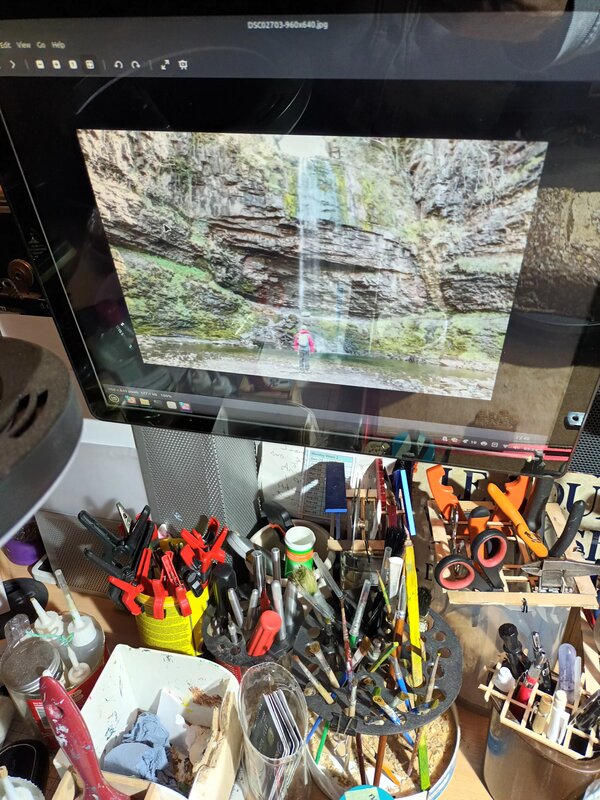
- This grounding in reality more valuable than generic model techniques
Layered Construction Process:
- Building in phases (base, rocks, water, vegetation, details) allowed each element proper attention
- Each phase built on previous work without disrupting earlier construction
- This sequential approach manageable and confidence-building
Challenges Overcome
Scale Management:
- At 1:250, every detail requires dramatic size reduction
- Solution: Focus on impression and atmosphere over precision
- Small-scale textures (fine moss, colored sawdust) essential
Vegetation Density Balance:
- Constant challenge: too much hides construction work, too little looks bare
- Solution: 60-70% coverage guideline, frequent stepping back, removal exercise
- Photography testing revealed what worked, what didn’t
Welsh Character vs. Generic Woodland:
- Risk of creating “forest scene” without regional specificity
- Solution: Moss emphasis, fern predominance, saturated greens, reference consultation
- Character comes from combinations not individual elements
Human Figure at 7mm:
- Extremely challenging scale for believable figure
- Solution: Wire armature for pose, air dry clay for form, Dremel for refinement
- At tiny scale, suggestion sufficient - perfect detail unnecessary
If Building Again
Would Do Differently:
- Perhaps create 2-3 figures in different positions for more narrative options
- Experiment with LED lighting integrated into base for waterfall backlighting
- Consider slightly larger scale (1:150?) allowing more detailed vegetation work
- Document construction process with more photos - some stages passed too quickly
Would Definitely Repeat:
- The reference-driven approach ensuring Welsh character
- Hybrid commercial/handmade construction philosophy
- Air dry clay + Dremel technique for figure work
- Multiple perspective exploration during finalisation
- The 60-70% vegetation coverage guideline
Skills Developed
Figure Sculpting:
- First attempt at miniature human figure at this tiny scale
- Wire armature construction techniques
- Air dry clay application and shaping
- Dremel precision work on dried clay
Narrative Composition:
- Adding human elements to pure landscape scenes
- Creating accessibility suggestions through path and figure
- Balancing realism with storytelling needs
Multi-Perspective Design:
- Creating scenes that work from multiple viewing angles
- Understanding how composition changes with viewer position
- Designing for photographic documentation
Welsh Landscape Interpretation:
- Capturing regional character through material and color choices
- Temperate rainforest microclimate representation
- Ancient woodland atmosphere creation
Next Steps
The Henrhyd Falls diorama is complete. Build Log #007 will present a curated gallery showcasing the finished work from multiple angles - a celebration of the complete miniature Welsh gorge with its dramatic waterfall, lush ancient woodland, and subtle human narrative elements that bring the scene to life.
The journey from planning through geological construction, water effects, botanical diversity, and final narrative details has been documented. The result: a 25cm × 25cm window into the Welsh landscape capturing the essence, atmosphere, and character of one of Wales’ most dramatic natural features.
- Final detail materials
Tools
- [TODO: List tools]
- Fine brushes
- Weathering tools
Next Steps
- Professional photography
- Gallery presentation
- Documentation completion
- Project reflection
Completion Date: November 30, 2025
Time Investment
This Session: [TODO: Hours spent]
Total Project Time: [TODO: Total cumulative hours for entire project]
Status: Finalisation complete, ready for photography
Next Log: Gallery and project completion
Completion Date: November 30, 2025
Have questions or feedback about this project? I'd love to hear from you.